
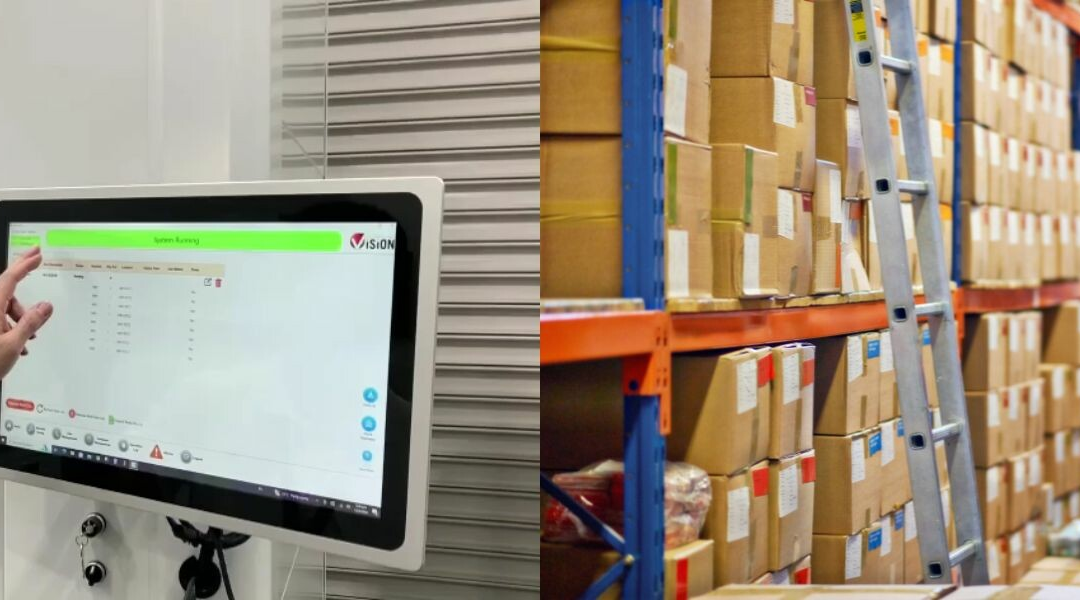
[page_toc]
Efficiency is often won or lost in the space between your floor and your ceiling. For decades, traditional static shelving has been the backbone of storage, relying on aisles and manual counting to keep inventory moving. However, as the digital age transforms supply chains, many businesses are finding that doing things the old way leads to wasted square footage and lost storage space.
The Vertical Carousel Storage System (VCS) is an automated solution that reimagines the warehouse as a high-density, interconnected hub.
But how does it truly stack up against the tried-and-true methods of traditional racking? In this analysis, we will break down the fundamental differences in technology, infrastructure, and safety to help you determine which system is ideal for you.
Key Takeaways
- A Vertical Carousel Storage System (VCS) serves as an active IoT node, providing real-time inventory data that traditional “silent” shelving cannot.
- By utilising vertical space and eliminating the need for wide access aisles, a VCS can recover your warehouse’s floor space, improving its overall efficiency.
- A VCS delivers goods to warehouse staff, boosting operational efficiency by eliminating time spent walking and searching.
- Ergonomics are vastly improved as items are delivered to a waist-high “Golden Zone,” reducing the risk of musculoskeletal injuries and ladder-related accidents.
- While traditional shelving has a lower upfront cost, a VCS provides superior long-term ROI through reduced labour, smaller real-time estate requirements, and enhanced stock security.
Vertical Carousel Storage System vs Traditional Storage: An Overview
The differences between a VCS and the traditional storage systems we’re familiar with can be best summarised through the table below:
| Vertical Carousel Storage System | Traditional Storage System | |
| Internet Of Things | Communicates with the warehouse or business’s warehouse management system (WMS) software to provide real-time inventory tracking | The shelves don’t report on inventory, nor do they connect with the warehouse’s other components. |
| Items and Infrastructure | These involve the VCS towers and an integrated WMS accessible via a console built into the VCS towers. | They consist of standardised or custom shelving made to store the warehouse’s inventory. |
| Footprint and Space Utilisation | The towers are compact and can be built vertically.
Since no ladders are required to retrieve units, no aisle space is required between towers. Footprint is small yet dense. |
Aisle space is crucial between rows of shelves, as ladders and forklifts may be required to retrieve items from higher racks.
The footprint is wide yet not relatively compact. |
| Ergonomics and Safety | A VCS has improved ergonomics and safety by bringing the necessary items to warehouse staff, rather than requiring them to climb shelves to retrieve them. | Traditional storage systems require warehouse staff to climb and retrieve items. |
What is Traditional Storage
Traditional storage is a Person-to-Goods system in which inventory remains in a fixed location, such as on shelves, racks, or in bins.
In this setup, the warehouse layout is defined by permanent aisles designed to allow employees or forklifts to navigate between rows of racking. Because the items are stationary, the system’s efficiency depends entirely on the physical movement of workers, who must travel to specific coordinates to store or retrieve products.
Traditional shelving is often limited by human reach or the height of standard manual equipment.
This results in wasted vertical space above the racks, as shelves would have to be arranged to allow human pickers and packers to retrieve items efficiently and safely.
Additionally, a substantial portion of the floor area is allocated to aisles rather than to product storage, resulting in a relatively low-density solution for high-volume inventory.
What is a Carousel Storage System
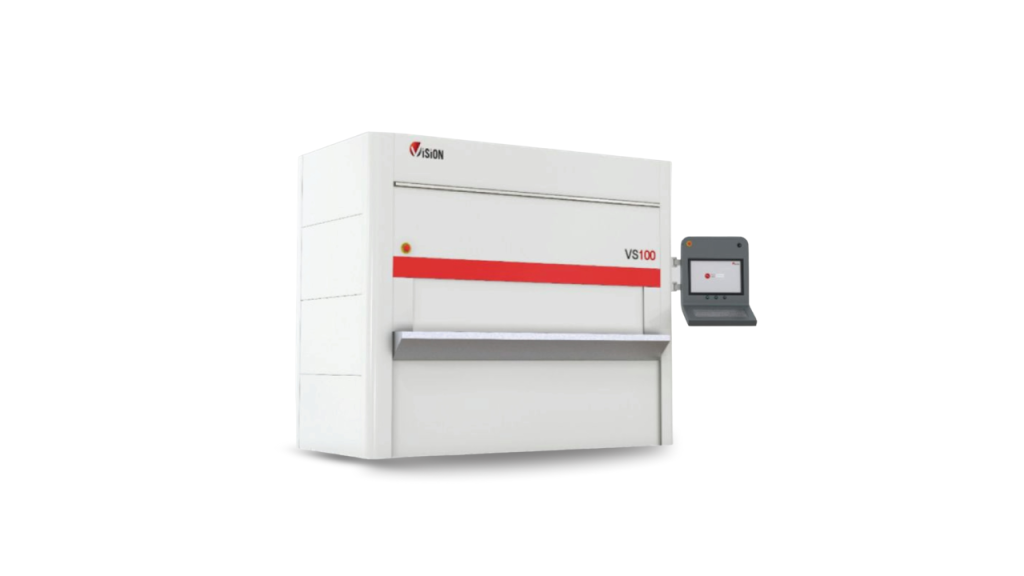
A Vertical Carousel Storage System (VCS) is an automated Goods-to-Person solution designed to maximise overhead space by functioning like a vertical conveyor belt or a giant Ferris wheel.
Inside a tall, enclosed steel cabinet, a series of carriers or shelves is linked to a chain drive that rotates vertically. When an operator requests a specific item via a computer interface, the system automatically rotates to bring the correct shelf directly to an ergonomically positioned access window at waist height.
The primary advantage of this system is its extreme spatial efficiency, as it transforms underutilised ceiling height into high-density storage.
A VCS also eliminates the need for wide permanent aisles, since ladders won’t be required to retrieve items. As a result, a VSC also maximises the horizontal space of a warehouse.
This allows businesses to store thousands of parts or files in a fraction of the floor space, effectively.
Beyond space savings, these systems significantly boost operational productivity and accuracy. Because the inventory comes to the worker, the “walking and searching” time inherent in traditional shelving is virtually eliminated.
Key Differences Between Vertical Carousel Storage and Traditional Storage
A VCS and a traditional storage solution differ in the following ways.
Understanding these differences will provide you with a better appreciation for warehouse workers and warehousing operations:
Internet Of Things
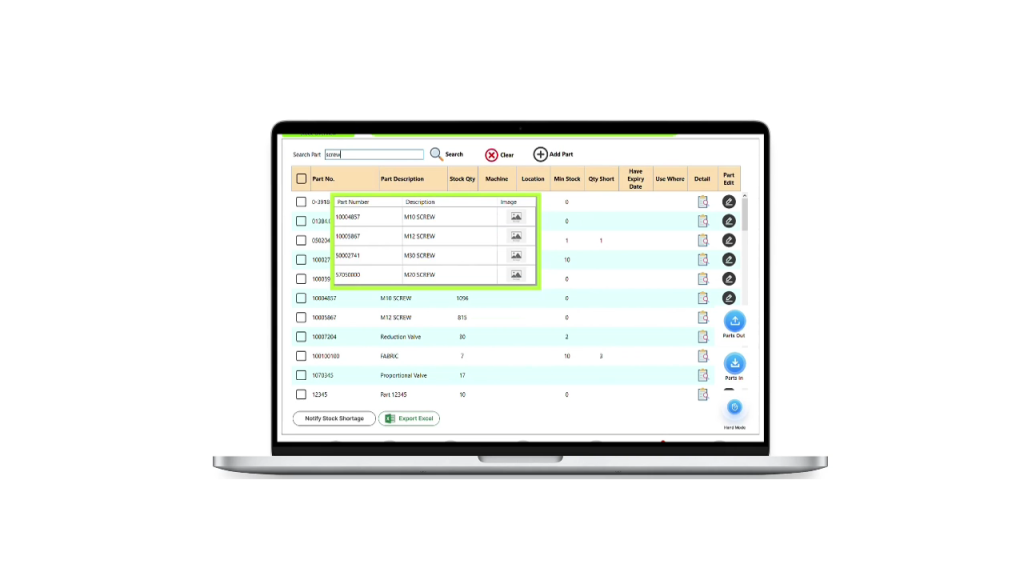
A Vertical Carousel Storage System functions as a sophisticated IoT node, equipped with integrated sensors, controllers, and network connectivity that enable real-time communication with a Warehouse Management System (WMS).
These systems can automatically track inventory levels as warehouse staff place items into the system and retrieve them, enabling more seamless and integrated inventory management.
In contrast, traditional storage is disconnected.
They consist of shelving solutions that cannot sense their own contents. To track inventory in a traditional setup, warehouse staff must physically count items and enter data into the WMS. Traditional solutions lack the native, holistic integration found in an automated carousel.
While you can digitise a traditional shelf using vision systems or wearable IoT tech on workers, the shelf itself remains a silent bystander, whereas the Vertical Carousel is an active, data-generating participant in the industrial network.
Items and Infrastructure Involved
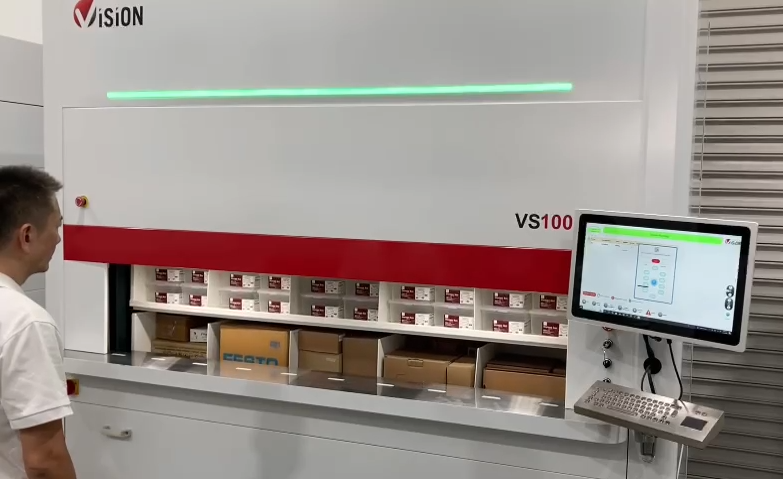
A vertical carousel is a self-contained, motorised machine that utilises the building’s verticality
It involves vertical carousel towers, modular units that can be built to a specified height. This structural difference shifts the storage strategy from horizontal expansion to vertical density.
Traditional storage is defined by static racking that relies on the building’s floor plate. The infrastructure consists of simple steel uprights and horizontal beams that create fixed rows, separated by wide aisles to accommodate human movement and heavy machinery, such as forklifts.
As a result, the components used to set up a vertical carousel storage system are more compact and dense, allowing inventory to be more tightly packed within a warehouse. In contrast, with a traditional storage setup, space must be allocated for walkways, reducing the warehouse’s horizontal footprint utilisation.
Footprint and Space Utilisation
Traditional storage is fundamentally a horizontal solution that requires a large floor footprint and wide, permanent aisles to allow personnel and machinery to access static racks.
In a typical warehouse using standard shelving, as much as 60% to 70% of the floor space is dedicated to empty aisle travel paths rather than actual product storage.
Furthermore, traditional racks are often limited to a height of 7 or 8 feet for manual picking, leaving the vast majority of a facility’s vertical space—the dead air between the top shelf and the ceiling—completely unutilized.
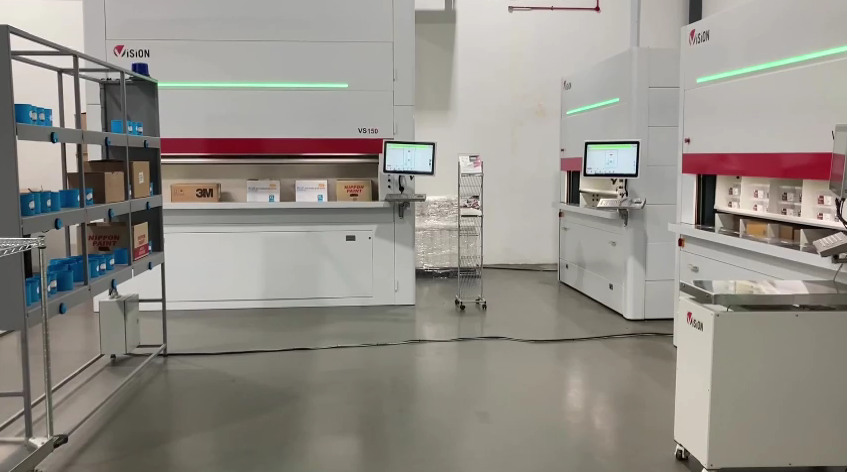
A Vertical Carousel Storage System recovers that wasted floor space.
By condensing inventory into a tall, enclosed mechanical unit, the system eliminates the need for multiple access aisles, requiring only a single, small footprint at the base.
This allows a facility to store the same volume of inventory in a fraction of the square footage, effectively trading low-density horizontal area for high-density vertical height.
Because the internal carriers rotate to the user, the system can safely utilise the full height of the warehouse.
Ergonomics and Safety
The traditional warehouse setup we’ve been accustomed to poses the following ergonomic and safety challenges:
- Workers must bend to reach lower shelves or use ladders to access higher bins. This constant activity leads to repetitive strain and an increased risk of musculoskeletal injuries over time.
- In a manual setup, pedestrians must share aisles with forklifts or heavy carts, increasing the risk of collisions
- Open racking leaves inventory exposed and prone to falling if bumped or improperly stacked, leading to injuries and stock loss.
A Vertical Carousel Storage System eliminates these physical stressors by rotating the required carrier to a waist-high access window.
This approach ensures that every pick occurs within the optimal ergonomic range, significantly reducing the physical fatigue associated with the constant searching and climbing required in a static shelving environment.
Furthermore, a Vertical Carousel is a fully enclosed system that serves as a protective barrier between the inventory and the operator, preventing items from falling off its shelves and striking people below.
While the upfront capital cost of metal shelving is lower than that of a VCS, the long-term costs in labour, time, and real estate are significantly higher than those of automated vertical systems.
Benefits of a Vertical Carousel Storage System vs Traditional Storage
Due to the differences between a VCS and traditional storage systems, a VCS results in the following benefits over traditional warehouse setups:
- More unified warehousing and inventory management: By functioning as a sophisticated IoT node, a VCS provides real-time, automated data synchronisation with your WMS, transforming a passive shelf into an active participant in your digital supply chain.
- Maximised warehouse footprint: A VCS recovers wasted floor space by utilising the full vertical height of a facility and eliminating the need for permanent, wide access aisles required by traditional racking.
- More efficient warehouse operations: The Goods-to-Person delivery model eliminates the time-consuming walking and searching inherent in static storage, significantly increasing picking speeds and accuracy.
- Safer warehouse day-to-day: The system delivers items through an ergonomic, waist-high window and provides fully enclosed housing, thereby reducing the risk of ladder falls, repetitive strain from bending, and forklift collisions in aisles.
How to Get a Vertical Carousel Storage System
Transitioning from traditional shelving to an automated solution requires a strategic approach to ensure the hardware aligns with your operational goals. Follow these steps to prepare for a successful integration.
Step 1: Assess Your Inventory

As efficient as VCS may seem, it may not be appropriate for all types of stock.
Vertical carousels are most effective for small- to medium-sized parts. At Vision One, our trays are 2 metres wide, and each machine has a gross payload of 2.5 tonnes.
Measure your most common bin sizes and calculate the total load capacity required per carrier. This will help you determine if your stock would fit inside a standard VCS, or if you’ll need a more specialised, custom automated storage solution.
Step 2: Assess Your Warehouse Space
Measure the floor-to-ceiling height, noting any overhead obstructions, such as HVAC ducts, fire sprinkler systems, or lighting fixtures, that may limit the unit’s height.
Additionally, evaluate your floor’s load-bearing capacity, as a fully loaded vertical carousel concentrates several tons of weight into a much smaller surface area than spread-out static shelving.
Vision One’s VCS dimensions are as follows:
- 2.35m length
- 1.4m width
- 2.25m height
This is for the stock VCS. These units can be built and modified to be taller, so be sure to also account for your warehouse’s vertical space.
Step 3: Get In Touch with a Vertical Carousel Storage System Provider

Once you have your inventory and space data, consult with a specialised automation partner to design a custom configuration.
A provider will assist you in selecting the appropriate model, integrating the unit with your existing Warehouse Management System (WMS), and planning the installation.
Get a Vertical Carousel Storage System Today!
Ready to transform your warehouse into a high-density, automated powerhouse?
At Vision One, we specialise in helping businesses transition from the limitations of traditional shelving to the high-speed efficiency of vertical automation.
Our Vision IoT Vertical Carousel Storage (VCS) units are designed to grow with your business, offering a modular, scalable solution that recovers your floor space while boosting picking accuracy.
Whether you are an SME looking for your first step into automation or a large-scale facility aiming to streamline complex inventory, our team provides end-to-end support—from initial space assessment to seamless WMS and ERP integration.
Don’t let dead air and manual bottlenecks hold back your operational growth. Contact Vision One today to schedule a consultation with our automation experts.
Frequently Asked Questions
What is the maximum height a Vertical Carousel Storage System can reach?
Most industrial units can be built to match your facility’s ceiling height, typically up to 10 or 12 metres, provided the floor can support the concentrated structural load.
How much weight can each individual carrier or shelf hold?
Payload capacities vary by model, but standard industrial carriers typically support 250 kg each tray, with the entire machine often capable of handling a gross payload of over 2.5 tonnes.
What happens to inventory during a power outage?
VCS units are equipped with manual override systems, such as a hand crank or emergency battery backup, allowing operators to rotate the carriers and retrieve critical stock during a blackout.
Can a VCS be integrated with my existing ERP software?
Yes, modern providers like Vision One design their systems to interface not just with Warehouse Management Systems (WMS), but also with major Enterprise Resource Planning (ERP) platforms for seamless supply chain synchronisation.
Is the system suitable for temperature-controlled environments?
Yes, vertical carousels can be specialised for cold storage or climate-controlled cleanrooms, as their enclosed design makes it easier to maintain consistent internal temperatures compared to open racking.
Can the internal shelf configuration be changed after installation?
While the main carriers are fixed to the chain drive, the internal dividers and bin configurations within those carriers are highly modular and can be easily rearranged to accommodate changing inventory sizes.